

Hopefully, you have already read the previous article. If not, I encourage you to, as it builds upon the foundations of this one. Regardless, I will quickly mention the key takeaways before getting into the important stuff. If you’ve already read it, you can skip this next paragraph.
Previously, we established that anxiety is an emotion, meaning that it is a label we use socially (i.e., fear, anger, frustration, desperation, etc.) to communicate our thoughts and physical sensations during a specific situation. We also explained that this takes place through classical conditioning (learning by pairing events and reactions), and that fear (and any experience, emotion, etc.) can be generalized. To exemplify how this works in anxiety, we used the example of a negative experience during a class presentation which quickly generalized to anxiety when raising your hand to answer questions in class, or having to confront another class presentation.
With that covered, I want to introduce how and why anxiety is maintained. After all, that is what most people go to therapy for:
- To understand why they continue to behave the way they do (maintenance)
- To understand how to change their behavior to improve their quality of life.
Expose, Escape and Avoid (EEA)
These three behaviors are the core elements that maintain anxiety, and the ones that allow us to regulate or reduce it. Using the graph below and the classroom presentation example, I will exemplify how each of these works. expose, escape, avoid.I want you to remember those three words:
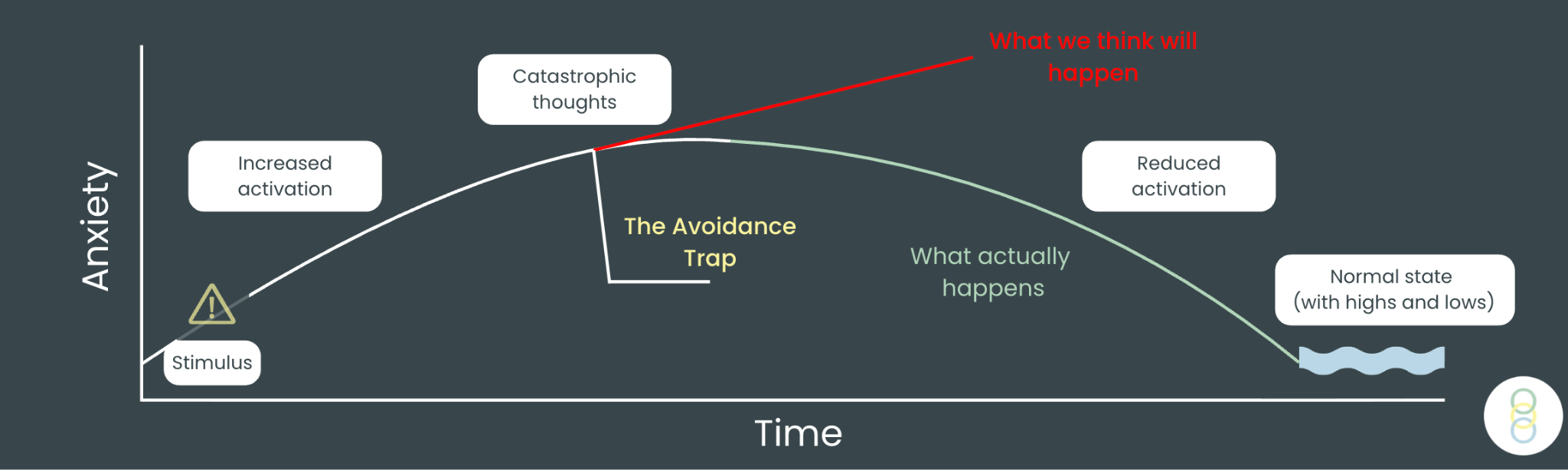
At the beginning of the curve, you have a situation (presenting in front of the class), which you have paired with unpleasant bodily sensations (heart racing, palms sweating) and thoughts. As the moment of the presentation gets closer, you begin to have catastrophic thoughts (i.e., “they’re going to make fun of me,” “I’m going to forget my words,” “my parents are going to be disappointed in me”).These thoughts follow the path of the red line, or what we think will happen. These are particularly scary because they anticipate an incoming danger, which only seems to get bigger.
Estos pensamientos siguen el camino de la línea roja, o lo que pensamos que pasará. Son particularmente aterradores porque anticipan un peligro inminente.
But, let's take a step back for a moment. At this point, do you have any evidence that these thoughts are accurate? The likelihood is no; it is a reaction based on past, unpleasant experiences which do not have to repeat themselves. Nonetheless, we often fall into the temptation of escape. escapar.
While escaping the presentation allows the anxiety to reduce (i.e., by going to the nurse's office and faking illness), the anxiety does not go back to where it used to be. Instead, the next time you have to present in front of the class, the anxiety will be significantly higher. While the short-term consequence is relieving, the long-term consequence is a worse situation than where you started, making you more likely to engage in avoidance.The next time, you may decide to not even show up for the presentation at all. The logic is clear: no presentation means no anxiety; no anxiety means no suffering.
But… what happens with your grades? What if instead of a class presentation, it was a date with a person you really like, or being present at the hospital when your loved one is ill?
What most people aren’t aware of is the green part of the curve, “what actually happens.”You see, anxiety, like any emotional experience, is finite. Your body is not able to maintain such a high level of alertness for such a long period, so it will eventually reduce.
Now, this is obviously easier said than done, but knowing this to be true can be encouraging to engage in the last word: expose.You see, the entire reason for the anxiety in this scenario was a bad experience during a class presentation. What do you think would happen to your anxiety levels if you did another class presentation and it actually went well? Or, at least, not as bad as you thought it would be? Would there be a need to anticipate such dire, life-ending consequences?
Normalizing the Anxious State
The whole purpose of these two articles was to educate, but also to normalize the final element of the curve. If you look closely at the end, there is a squiggly line that is oftentimes overlooked. As a psychologist helping people to understand and manage their anxiety, this is the most important part, because it deals with the premise that all these “anti-anxiety treatments” fail to address: anxiety, like all emotions, is innate to the human experience and cannot be eliminated.
The key is in understanding when the alarm system is acting up unnecessarily.
Leave a Reply